

How Long Does It Take For At&t To Unlock Your Phone

COVID-19 symptoms vary person to person, as does the length of the coronavirus infection. If you're sick, employ caution when deciding to leave isolation. Justin Paget/Getty Images hide caption
toggle explanation
Justin Paget/Getty Images
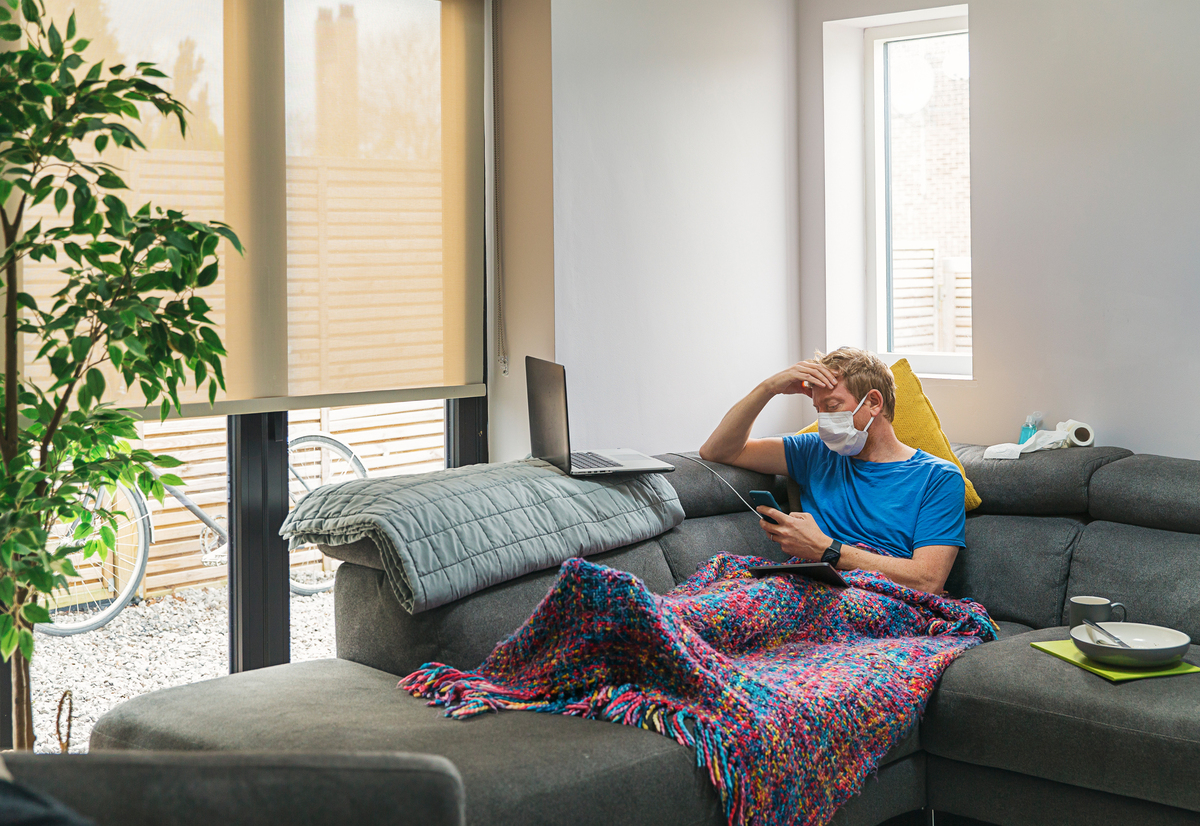
COVID-nineteen symptoms vary person to person, as does the length of the coronavirus infection. If you're sick, utilize caution when deciding to leave isolation.
Justin Paget/Getty Images
Around the earth, COVID-19 cases and deaths continue to grow each day. All the same, there are also more than than 440,000 people globally who have recovered to engagement.
For those who have had the illness, recovery can be a slow journey. And even after you're feeling better, at that place can be a flow of uncertainty. After days or weeks of isolation, you may be eager to run into family unit over again and even pace foot into the outer world. Only how soon is too soon? And how do you lot know when y'all're no longer infectious?
For answers, we've turned to several experts, including ii doctors who both got diagnosed with COVID-xix in mid-March and have since recovered. Rosny Daniel, 32, an emergency department doctor at the Academy of California, San Francisco, is back on the job and feeling "completely back to normal." And Darren Klugman, 45, a pediatric cardiologist, says he'southward feeling "100%" and is also back to piece of work after isolating himself away from his family.
Klugman says the news of the rising COVID-19 deaths is heartbreaking and sobering. He says it points to the disquisitional need for pandemic planning. Merely he says information technology's near as of import to realize how many people are recovering. "The bulk of people volition accept a mild-to-moderate influenza-like illness like I had," Klugman says.
He says that it's disquisitional for everyone to follow social distancing guidelines and that if you do doubtable you may be sick — whether or not you accept tested positive — have action to protect yourself and those around you. "Virtually important is recognizing the symptoms early on, isolating oneself and really strictly abiding past the quarantine rules," Klugman says.
Am I well nevertheless? What to spotter for if you think you're getting well.
Daniel says people who get COVID-19 tin can have a wide range of symptoms and the severity of the sickness tin range a great deal from person to person. "It's incredibly confusing, and there is a large amount of unpredictability to it," he says.
Just keep an centre out if you think you're better after a few days, because you lot may still get worse. Daniel says for the beginning few days of his illness he had aches and chills. He developed a fever and a mild cough and felt wiped out, tired. "My muscles hurt really bad in my legs. I felt really sore," he says. "[Information technology was] painful to the betoken that they felt like they were tingling."
He started to experience better, only then, on day seven, the symptoms came back and he started to also have trouble breathing.
He has mild asthma and Type 1 diabetes, two underlying conditions linked to an increased gamble of serious disease. He began using his inhalers to treat the asthma. He too took an antibiotic to treat what may have been a secondary bacterial infection in his lung. After several days, he felt much improve.
Klugman says he felt sick for about ten days. At first he had "intermittent chills and body aches," and and so he developed a low fever and a "very prominent cough." Based on these symptoms, he quarantined himself abroad from his family for 14 days, earlier he even got the positive COVID-19 exam results.
"By mean solar day 10, I was feeling my energy level was near normal," Klugman says, but he says his cough persisted for a while longer. Now, he says, he's completely recovered and even back to going running.
Equally a medico, Daniel says, he's really eager to run into more testing and improve data on COVID-19: "Right at present it feels a little bit like we are fighting with a blindfold on. We're trying to get every bit much data as possible."
What are the guidelines for when you can stop isolating yourself afterwards you've been sick?
The Centers for Disease Control and Prevention issued guidance proverb people with COVID-nineteen can stop isolating themselves when they've been fever free for 72 hours — that's 3 days after the fever ends. And to notation: That is without the use of fever-reducing medicine. This should back-trail an improvement in respiratory symptoms, such equally cough and shortness of breath, and should be at to the lowest degree 7 days from the onset of initial symptoms.
The CDC says testing can as well inform the decision. Simply the test-based strategy that the CDC suggests involves getting negative results on two tests, with samples nerveless at least 24 hours apart. Given the difficulties with testing, that may non exist realistic for most people right now.
After self-isolation, recovered patients who are returning to piece of work and public spaces should however follow the mitigation recommendations for anybody, such as avoiding groups and washing hands. Right now, most people are under stay-at-abode orders, so trips outside may be limited anyhow.
For health care workers, some institutions have put in place additional guidance edifice on the CDC's.
Daniel was off work for nearly three weeks. His hospital used a specific process to articulate him dorsum to work. "The guideline we're using is 14 days by initial symptoms, plus 72 hours of no symptoms," Daniel told us.
It's worth noting that the CDC says this is all based on limited information — then this guidance could change equally it learns more.
Given that some people's symptoms reoccur at twenty-four hour period seven, as Daniel's did, he says there'south reason to be cautious. To exist bourgeois, you might want to wait a couple of extra days before leaving self-isolation, in case you lot backslide.
What does the science say nigh how long people may stay contagious after they've recovered?
It's non fully known how long a person with COVID-19 is infectious. "A rough guide for other infections is that infectiousness drops when the fever subsides," says Ben Cowling, a professor of public health at the University of Hong Kong.
Aaron Carroll, a professor of medicine at Indiana Academy, says there's nevertheless some doubt. "We still don't accept enough data to really know how long people are infectious," he says.
And he says some doctors are concerned about the CDC'due south guidelines. "I volition tell you that I retrieve a lot of people I know are uncomfortable with that guidance. They think that it may not be as conservative as it needs to exist," Carroll says.
Cowling says studies are underway to evaluate how long the body continues to shed the virus afterward someone starts to get better. But, he adds, at that place is not a directly link betwixt shedding and infectiousness.
One meta-report looking at over 100 cases constitute RNA from the virus in stool samples up to 33 days after onset of the illness, even subsequently the patients had tested negative using samples from their respiratory tracts. But the researchers noted that they didn't know if these were only RNA fragments or active virus particles that could infect someone.
I experience well and back to normal. When tin I meet my older family members again?
A lot of people who feel amend would similar to reconnect with family members — perchance with elderly parents. Simply that's not prophylactic nonetheless, says Sean Morrison, a geriatrician and palliative intendance specialist at the Mount Sinai Health System.
Older people are more vulnerable to COVID-19, and 8 out of 10 deaths reported in the U.Due south. take been among adults who were at least 65 years old, according to the CDC.
"What I strongly recommend is that in-person visits to older family members remain only if needed and, at that, infrequent," Morrison says. To provide things like groceries and medications, some visits may be necessary, but they should be express as much as possible. "Particularly for older adults, the strong isolation and physical distancing required is really hard," he adds. "And even so it is what is going to become the states through this."
Will I be allowed to reinfection later I've had COVID-19, or could I get it once more?
The CDC says the full immune response, including duration of immunity, is non all the same fully understood. Then, in that location's some uncertainty.
"I promise that my antibodies are all ramped up and I'1000 protected from getting sick again, but I don't know that for sure," Daniel says. "Then I'm treating it as if I don't have amnesty, and I wearable full protection at all times, by our hospital's guidelines, to make sure I'm withal protecting myself."
So far, there's most no data, and no long-term data, on the virus that causes COVID-nineteen (called SARS-CoV-2), then it'south speculative to say how long immunity may final after being infected.
"Based on immunity to SARS [and] MERS, and seasonal coronaviruses, a reasonable expectation is that most, and maybe nearly all, people who have been infected with SARS-CoV-2 will take amnesty for a yr or more," says Marc Lipsitch, an epidemiologist at the Harvard T.H. Chan Schoolhouse of Public Wellness. This immunity will likely protect people "at least confronting astringent disease and confronting shedding a lot of virus that would make them highly contagious," Lipsitch says.
He says this best guess is informed by what scientists documented in the blood of people who had recovered from SARS and MERS, which too are caused by coronaviruses. Lipsitch says these studies advise that the people's defenses confronting the viruses seemed to last a while, about two years for SARS and, for MERS, near three years.
Lipsitch says more research is needed to determine how long people are protected afterward COVID-19. "We need to design studies where individuals with known COVID-19 infection and without infection are followed over time to assess whether the outset group is protected, or partially protected, against COVID-19 infection compared to the 2d group," Lipsitch says. He says these studies are challenging to design, but he and some colleagues are currently trying to practice so.

How Long Does It Take For At&t To Unlock Your Phone,
Source: https://www.npr.org/sections/health-shots/2020/04/13/833412729/how-long-does-it-take-to-recover-from-covid-19-and-how-long-are-you-infectious
Posted by: rowleysaidom68.blogspot.com
0 Response to "How Long Does It Take For At&t To Unlock Your Phone"
Post a Comment